Class vs example#
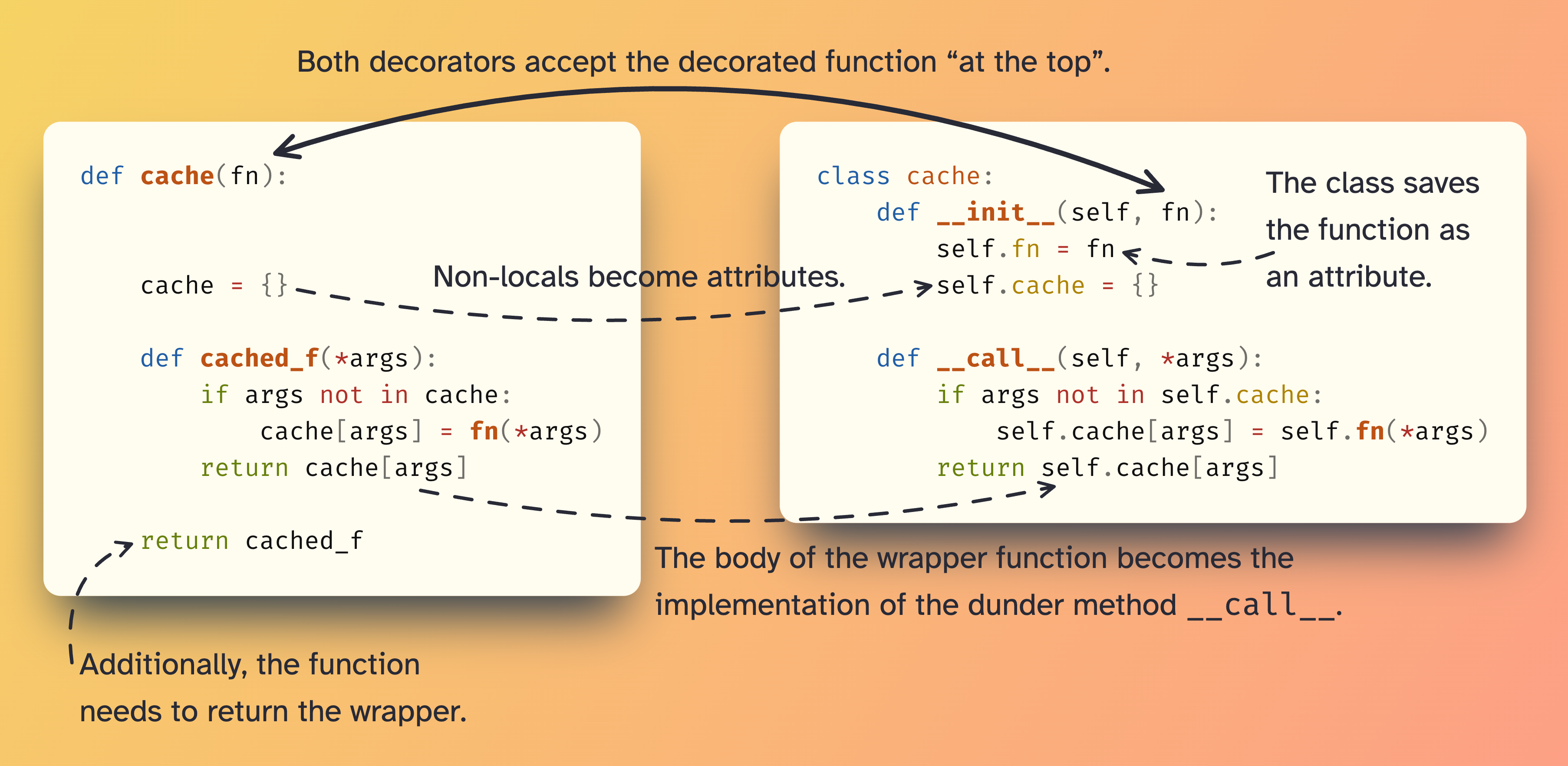
As an example of what a useful decorator might look like when implemented as a class, consider the decorator cache implemented below:
class cache:
    def __init__(self, fn):
        self.fn = fn
        self.cache = {}

    def __call__(self, *args):
        if args not in self.cache:
            self.cache[args] = self.fn(*args)
        return self.cache[args]
This implementation of the decorator cache mimics the caching decorator that you developed earlier in this course:
both accept the function “at the top”:
the function decorator accepts it as its argument; and
the class-based decorator accept it as the argument in
__init__.
the class-based decorator uses attributes to save the information that the function decorator saves implicitly in its closure:
the function argument must be saved as an attribute; and
all other variables created inside the closure and that are accessed by the wrapper must be turned into attributes.
the wrapper function becomes the dunder method
__call__of the class-based decorator; andthe function decorator needs to return the wrapper so it replaces the original function and to make it accessible but the class-based decorator doesn’t return anything because the instance will automatically be available to the user.
The diagram below represents these relationships: